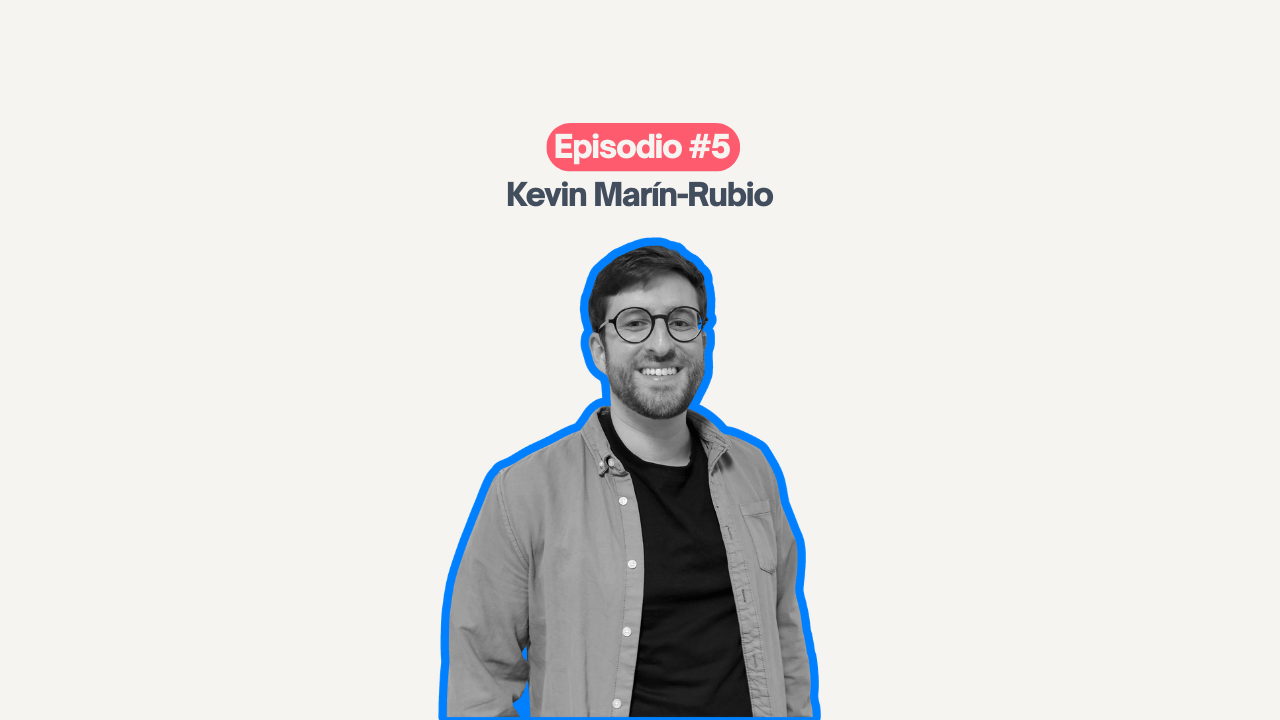
Kevin Marín: “What kind of desirable future would it be if we didn’t talk about playing and we didn’t play?”
Kevin, a predoctoral researcher at the UB, was the guest on episode #5 of Playcomp.
The fifth episode of the Playcomp podcast is now available on streaming platforms. In this episode, Alejandro talks with Kevin Marín Rubio, a predoctoral researcher at the University of Barcelona and a member of the Playcomp team, whose doctoral research connects video games, critical pedagogy, and educational processes. Kevin discusses his thesis, Play Utopia, an initiative through which he shares his experience using independent games to encourage critical thinking in teenagers.
Throughout the episode, Kevin and Alejandro reflect on the potential of video games as a tool for understanding the contemporary world and creating more critical and participatory educational spaces. During the conversation, Kevin shares how he uses video games in educational contexts to encourage students to reflect on the reality they inhabit and, from there, imagine other possible futures through play. Along these lines, he emphasizes the importance of critical pedagogy: “When we talk about critical pedagogy, one of the most important things is to link abstract concepts and this future we would like to avoid with our daily lives and our identity.”
One of the central ideas of the episode revolves around the role of the game in human and educational experience. In this sense, Kevin poses a question that runs through much of the interview: “What kind of desirable future would it be if we didn’t talk about playing and didn’t play?”
Furthermore, the researcher highlights the active role of both video games and the teacher in educational processes: “In general, when educational mediation is done with video games, you do not only start from the conflicts that the game presents, but you, in your teaching mediation, can generate conflicts and activities from the game.”
Kevin also shares specific examples with Alejandro of video games used in educational mediation processes, such as Unpacking , a game in which the player reconstructs a person’s life through the objects present during a move. Based on these kinds of experiences, the researcher points out how video games can spark conversations about identity, coexistence, and memory in the classroom.
You can watch and listen to the latest episode here:
The Playcomp podcast is a scientific outreach initiative that explores the use of video games in education from a research and applied perspective, focusing on the development of civic and socio-emotional skills.
Playcomp is a project funded by the Spanish State Research Agency. It has a team of 17 researchers from 12 European universities who are analyzing teachers’ video game literacy. Its main objective is to enrich students’ educational experience and promote the development of civic and socio-emotional skills through the use of independent video games.